
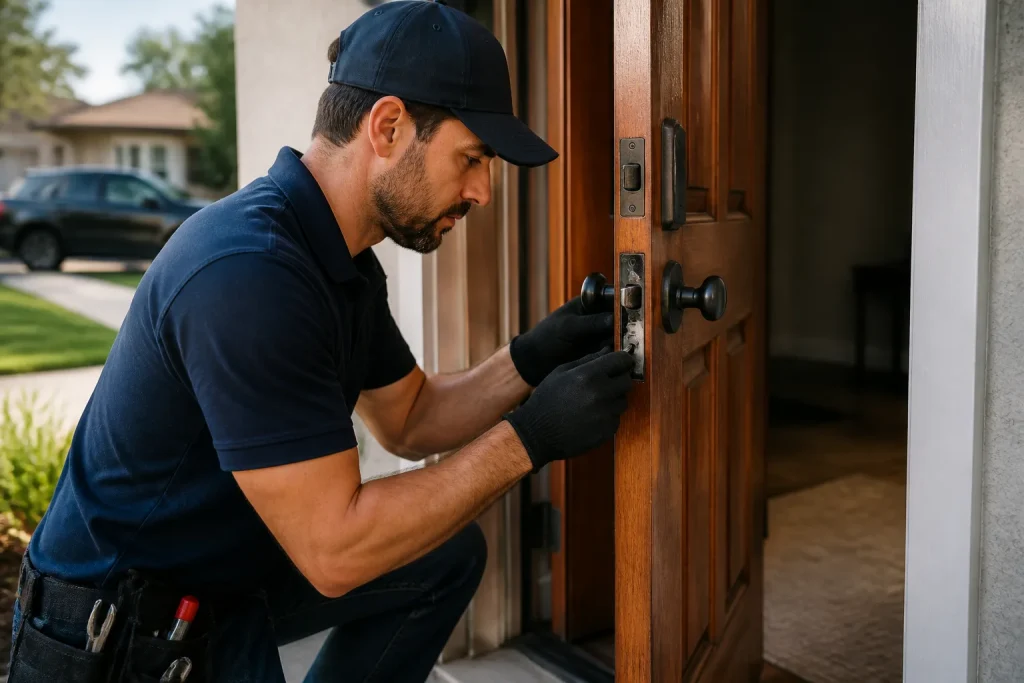
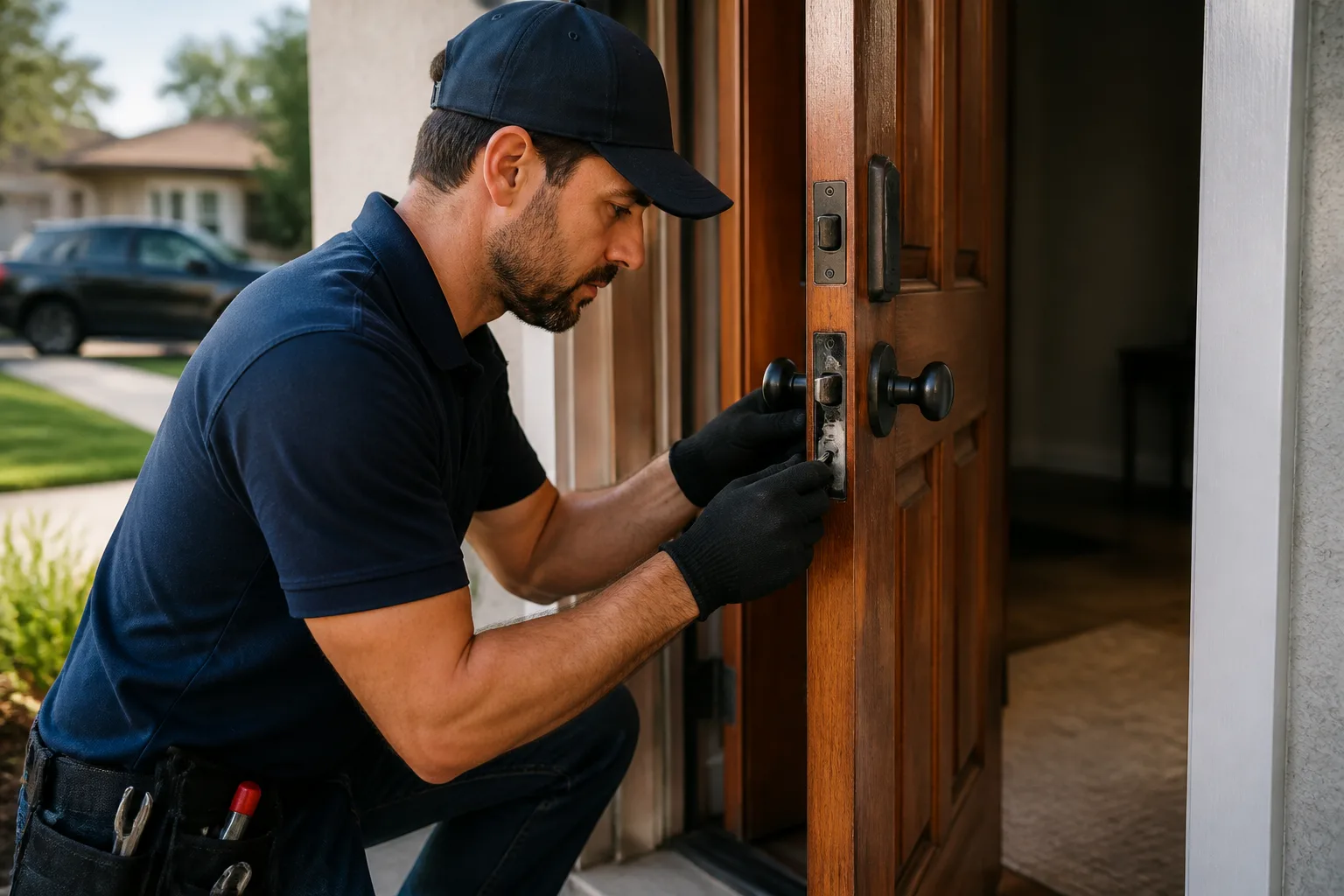
Door Lock Repair: Repair or Replace? How Los Angeles Homeowners Decide
Most Los Angeles homeowners can repair a door lock for $95 to $210, and replacement only makes sense when the door assembly itself has failed. Before you spend $180 to $400 on new hardware, check the strike plate screws, the jamb wood, and the door-to-frame gap. Those three things decide the question more often than the lock does. If you’d rather not sort through it yourself, call Dunmore Locksmith at (910) 714-4287 and we’ll walk you through it over the phone for free.
Here’s the thing nobody tells you: a standard residential strike plate in Los Angeles is held by half-inch screws into a hollow door jamb. A force of about 150 pounds kicks it free. No lock repair on earth fixes that. Which means the most important question in any lock service call is one most technicians never ask: is the door itself still worth locking?
Start With the Door Assembly, Not the Lock
We’ve been doing door lock repair in Los Angelesand the pattern is consistent. A homeowner calls because the deadbolt won’t turn or the knob spins loosely. They assume the lock is failing. About half the time, the lock is fine, and the door has shifted. In hillside neighborhoods like Echo Park, Mount Washington, and Baldwin Hills, dry season soil movement tilts door frames a few degrees. The latch no longer lines up with the strike plate, so the key turns hard, the knob binds, and the deadbolt throws only halfway.
Before you decide anything, run this five-minute audit:
- Strike plate screws: Remove one screw. If it’s half an inch long, the door can be kicked open regardless of what lock you buy.
- Door-to-frame gap: Run a butter knife along the latch side. A gap wider than an eighth of an inch at the latch point means the door has moved or the weatherstripping has compressed.
- Hinge screws: Loose top hinges make doors sag. The latch drops below the strike hole, and every key turn fights gravity.
- Strike plate depth: The plate should sit flush or slightly recessed in the jamb. A proud plate catches the latch and wears it down over years.
If the lock turns smoothly when the door is open but binds when closed, the door has shifted. That’s a door problem wearing a lock costume. Repair is the right call, but it has to include realigning the strike plate or adjusting the hinges, not just squirting lubricant into the cylinder.
Why a $8 Upgrade Changes the Replacement Math
The cheapest, highest-impact fix in residential locksmithing is swapping half-inch strike plate screws for 3-inch screws. In Los Angeles, where break-in attempts on older homes in neighborhoods like West Adams and Highland Park often start with a shoulder against the door, this upgrade is the difference between a door that holds and one that folds.
The 3-inch screws pass through the jamb and bite into the structural framing behind it. The strike plate stops being a decorative plate and becomes a structural anchor. Total cost: about $8 in hardware and fifteen minutes of labor. If that’s the only thing wrong, you don’t need a new lock. You need a technician who will ask the right question.
We make this point because the industry norm is to sell a new lock. Repair labor generates less revenue than hardware replacement, so a careless technician will tell you the lock is worn out when the jamb is the actual failure. That’s the specific failure the Done Right Promise at Dunmore Locksmith exists to prevent: if the repair doesn’t hold for a full year, we return at no charge. The guarantee is written on every job, not just mentioned in a phone call.
When a Hard-Turning Lock Means the Lock Is Failing
Separating door shift from genuine lock wear is simpler than it sounds. Open the door halfway. Turn the key. If it operates smoothly with the door open, the door is the problem. If it grinds, catches, or resists even with no frame contact, the lock internals are worn or fouled.
We pulled a Kwikset deadbolt out of a front door in Silver Lake last month that a homeowner had been fighting for two years. The tailpiece, the little connector between the cylinder and the bolt mechanism, had worn into an oval. Every turn of the key was a negotiation. A new cylinder and tailpiece had that lock working like the day it was installed, for about $120. no new door, no new hardware set. The customer assumed replacement was inevitable because two previous technicians told her so. Neither had bothered to open the lock up.
Los Angeles dust makes this worse. Fine particulate from dry air and construction settles into keyways and pins. Graphite and oil turn that dust into a paste that gums up springs. When a key inserts but won’t turn, or turns only if you jiggle it upward, the cylinder is fouled or the pins are worn. That’s a repair: disassemble, clean, lube with a dry film, replace worn pins. A quality brand like Schlage or Medeco will take this service and run another decade.
Latent Damage From Forced Entry: What Looks Cosmetic but Isn’t
Los Angeles homeowners often live in homes with attempted break-in history they never knew about. A previous owner replaced the lock but left the damage, or a landlord patched the visible scar and called it done. Latent damage hides in three places:
- Bent deadbolt bolts: A bolt that was kicked while thrown can bend a few degrees. It still extends and retracts, but under load it binds. You won’t see it until the door is closed and pressure is applied.
- Cracked jamb wood behind the strike plate: The plate covers the crack, but every close of the door works the split wider. Eventually the deadbolt has nothing solid to seat into.
- Deformed strike boxes: The metal cup the latch enters can be ovaled from force. The latch rattles, the door wobbles, and the lock never feels secure.
None of these conditions are fixed by buying a new Kwikset or Yale knob. They’re fixed by inspecting the assembly and replacing what’s actually damaged. In one house off Figueroa in Highland Park, we found a strike box so wallered out that the deadbolt had been throwing into the wall cavity behind it for at least a year. The homeowner thought the lock was broken because the key turned but the door never felt sealed. The fix was a new reinforced strike, not a new lock.
The Decision Matrix: Repair or Replace in Los Angeles
Here’s how to make the call in plain terms.
Repair is the right call when:
- The lock operates smoothly with the door open but binds when closed.
- The cylinder is gummed, worn, or stiff but the bolt and latch are intact.
- The hardware is a quality brand like Schlage, Medeco, or Baldwin, in good physical condition.
- The door frame is solid, the hinges are tight, and the strike screws are 3-inch or can be upgraded.
Expect to pay between $95 and $210 in Los Angeles for a cylinder rebuild, rekey, and strike plate adjustment on a standard knob or deadbolt. The full price goes in writing before any work starts.
Replacement is non-negotiable when:
- The door jamb is cracked, rotted, or has been kicked in at the strike point.
- The lock body itself is physically broken: a snapped cylinder, a stripped tailpiece mount, or a deadbolt that won’t throw under any condition.
- You’re buying a home and don’t know who has copies of the existing keys. In that case you don’t even replace hardware necessarily; you rekey, which the residential locksmith team in Los Angeles handles daily for $65 to $125.
- The existing hardware is a no-name import with a thin bolt, a plastic core, or a cylinder that turns with a screwdriver. Upgrading to a Kwikset SmartKey, Schlage B60, or a Medeco high-security cylinder is the honest fix for security, not just function.
Baldwin and Yale hardware wear beautifully, but when the internal chassis cracks, replacement is the only honest answer. Repairing a cracked chassis is a temporary patch that fails under stress. We won’t do it, even when a customer asks.
Why the Frame Audit Has to Precede Every Lock Decision
Most Los Angeles lock service calls should be Dunmore Locksmith home page territory in the sense that a real locksmith is a door-assembly mechanic before they’re a lock installer. The order of questioning matters. Lock first, door second, is how you waste money. Door first, lock second, is how you get secure.
The Threshold Standard, the vetting process every Dunmore technician goes through, includes training on exactly this. Our techs are background-checked and identity-verified. They arrive in clean marked uniforms with a photo ID badge, and you get their name and photo before the visit. So the person examining your jamb and strike plate is someone you know before you open the door. That matters in Los Angeles, where a knock at the door is as often a stranger as it is a neighbor.
When to call a pro: if the audit takes you more than five minutes, if you can’t identify the screw length, or if the door binds under its own weight when you lift the handle, get a second set of eyes on it. Door problems hide in the margins, and a trained eye catches what a quick once-over misses. Related services we handle every week in Los Angeles include full door lock repair, rekeying after move-in, and complete lock changes for new construction and renovations on the change door locks in Los Angeles side.
A fort with a new gate but a rotten wall is not a fort. The lock is the gate. The jamb is the wall. Both have to hold.
The Bottom Line
Repair or replace isn’t the right way to frame the question. The right way is: what failed, the lock or the door? In Los Angeles, shifting soil, dry dust, old frames, and prior forced-entry attempts all masquerade as lock problems. If the door is solid and the lock is a quality brand, repair is almost always the economical and correct move. If the jamb, strike plate, or lock body itself has failed, replacement is the only honest answer. Never buy a new deadbolt before someone checks the strike screws.
If you’re in Los Angeles and need help deciding, Dunmore Locksmith offers free estimates over the phone. Call (910) 714-4287, describe what you’re seeing, and we’ll give you a straight answer and a written price before anyone steps onto your property. No surprise totals, no upsell, no pressure.
Frequently Asked Questions
Door lock repair in Los Angeles typically runs $95 to $210 for a standard knob or deadbolt, including cylinder service, rekeying, and strike plate adjustment. If the jamb or lock body is broken, replacement raises the total to $180 to $400 depending on hardware grade. Call (910) 714-4287 for an exact quote, the price we give you before dispatch is the price on the invoice.
Open the door and test the lock. If it turns smoothly with the door open, the door has shifted and the lock is probably repairable. If it remains stiff with the door open, the lock internals are worn or fouled and may still be repairable with a cylinder rebuild. If the lock body is cracked or the jamb is split, replacement is required. Dunmore Locksmith includes this diagnostic in every free phone estimate.
You don’t necessarily need new locks; you need the existing locks rekeyed. Rekeying changes the internal pins so old keys no longer work, and it runs $65 to $125 in Los Angeles. If the existing hardware is a no-name import, upgrade to a Schlage, Kwikset, or Medeco rather than rekeying a weak lock. Call (910) 714-4287 and we’ll tell you what you have and what it needs.
Yes. Written price delivered before any work starts, every single time, no exceptions. That’s the Dunmore Locksmith policy and we don’t bend it. If a repair needs more work than the quote anticipated, you’ll hear about it and approve it in writing before we proceed. If the repair fails within 365 days, we return at no charge under the Done Right Promise.
Written by the team at Dunmore Locksmith.
Need Locksmith Help?
Call Dunmore Locksmith - licensed & insured, here with fast after-hours help in Los Angeles.
(910) 714-4287